 Santa Cruz, Scotts Valley CA
Dental implants are often described as a long-term solution for missing teeth. But does that mean they last forever?
Not necessarily.
Dental implants can remain functional for many years, and some last for decades. However, their longevity depends on several factors, including oral hygiene, bone and gum health, medical conditions, and the type of restoration attached to the implant.
If you’re considering implants, understanding what affects their lifespan can help you protect your investment and set realistic expectations.
What Is the Average Lifespan of a Dental Implant?
Dental implants have demonstrated high survival rates in long-term clinical studies, with many studies reporting survival above 90% over approximately ten years.
However, survival rates vary depending on the patient population, implant location, treatment technique, and follow-up period.
A surviving implant is not necessarily free of complications.
Some patients require treatment for inflammation, mechanical problems, or issues involving the attached restoration.
Rather than assuming an implant will last a lifetime, it’s more accurate to think of it as a long-term restoration that requires ongoing care.
Do the Implant and Crown Last the Same Amount of Time?
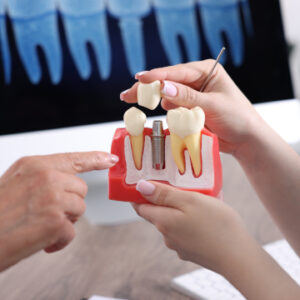
A dental implant restoration typically includes several components.
- The implant fixture is placed into the jawbone and acts as the foundation.
- The abutment connects the fixture to the replacement tooth or other prosthesis.
- The crown is the visible restoration that resembles a natural tooth.
These components do not necessarily have identical lifespans.
The implant fixture may remain stable for many years while the crown experiences wear, chipping, or other damage that requires repair or replacement.
For this reason, replacing an implant crown does not always mean the implant itself has failed.
What Causes Dental Implants to Fail?
Implant complications can occur during the initial healing period or years after treatment.
Early failure may occur when the implant does not successfully integrate with the surrounding bone.
Later complications may involve inflammation, infection, excessive mechanical stress, or other factors.
One important concern is peri-implantitis, an inflammatory condition affecting the tissues surrounding an implant.
It can lead to progressive bone loss and, in severe cases, implant failure.
Other potential complications include loosening of restoration components, fractured crowns, and changes in surrounding tissues.
Early detection is important because some problems can be managed more effectively before they become advanced.
How Does Oral Hygiene Affect Implant Longevity?
Although implants cannot develop tooth decay, the surrounding gums and bone still need protection.
Plaque can accumulate around implant restorations just as it does around natural teeth.
If plaque isn’t adequately controlled, inflammation may develop in the surrounding tissues.
To care for an implant:
- Brush thoroughly twice a day.
- Clean between teeth and around the implant as directed.
- Use dental hygiene tools recommended for your restoration.
- Attend regular professional cleanings.
- Report bleeding, swelling, or discomfort around the implant.
Patients with implant-supported bridges or dentures may need specialized cleaning techniques to reach beneath the restoration.
Does Gum Disease Affect Dental Implants?
A history of periodontal disease is an important risk factor for future peri-implant problems.
Patients who have experienced gum disease may need closer monitoring and individualized maintenance schedules.
This doesn’t mean they cannot receive implants.
It means controlling periodontal inflammation before treatment and maintaining healthy tissues afterward is particularly important.
Routine dental visits help identify changes that may not cause noticeable symptoms initially.
Can Smoking Shorten the Life of Dental Implants?
Smoking is associated with higher rates of implant complications and failure.
It can affect wound healing and the health of tissues surrounding the implant.
For patients who smoke, stopping tobacco use can improve overall oral health and may reduce some treatment risks.
Your dentist can discuss how smoking and other individual factors influence implant prognosis.
Can Teeth Grinding Damage Dental Implants?
Dental implants can tolerate normal chewing forces, but excessive loading may contribute to mechanical complications.
People who grind or clench their teeth may be more likely to experience certain problems involving implant crowns or other prosthetic components.
The relationship between bruxism and implant failure is complex, and grinding does not automatically cause an implant to fail.
However, your dentist may consider your bite, chewing habits, and restoration design when planning treatment.
In some situations, a protective appliance may be recommended.
How Often Should Dental Implants Be Checked?
There is no single maintenance schedule that fits every patient.
Your dentist may recommend periodic examinations based on your oral health, history of gum disease, implant restoration, and other risk factors.
During these appointments, the dental team may assess:
- Gum and tissue health
- Plaque accumulation
- Stability of the restoration
- Changes in your bite
- Signs of inflammation
- Bone levels when imaging is indicated
Consistent maintenance can help identify problems before they become more serious.
What Are the Warning Signs of Implant Problems?
Contact your dentist if you notice:
- Bleeding or swelling around an implant
- Persistent discomfort
- Pus or unusual discharge
- A loose crown or restoration
- Changes in how your teeth fit together
- Difficulty chewing
- Movement of the implant itself
An implant that feels loose requires prompt professional assessment.
Not every symptom means the implant has failed, but ignoring changes can allow a problem to progress.
Are Dental Implants Worth the Long-Term Investment?
For many appropriately selected patients, dental implants offer a stable and functional way to replace missing teeth.
Their value depends on more than the number of years they last.
Comfort, chewing ability, appearance, maintenance requirements, and the cost of potential repairs all matter.
A personalized treatment plan should include a realistic discussion of expected outcomes and ongoing care.
Long-Term Restorative Dental Care in Scotts Valley
Dental implants can provide years of function, but their long-term success depends on both professional care and daily maintenance.
At Ebrahimian Integrative Dentistry, we recognize the importance of protecting your oral health throughout every stage of restorative treatment.
If you’re considering implants or have questions about caring for an existing dental restoration, our Scotts Valley office can help you explore appropriate next steps.
Ebrahimian Integrative Dentistry
5 Erba Ln, Suite A
Scotts Valley, CA 95066
Call (831) 438-4411 to schedule a dental consultation.